Leadership
Take responsibility, guide teams and make thoughtful decisions.
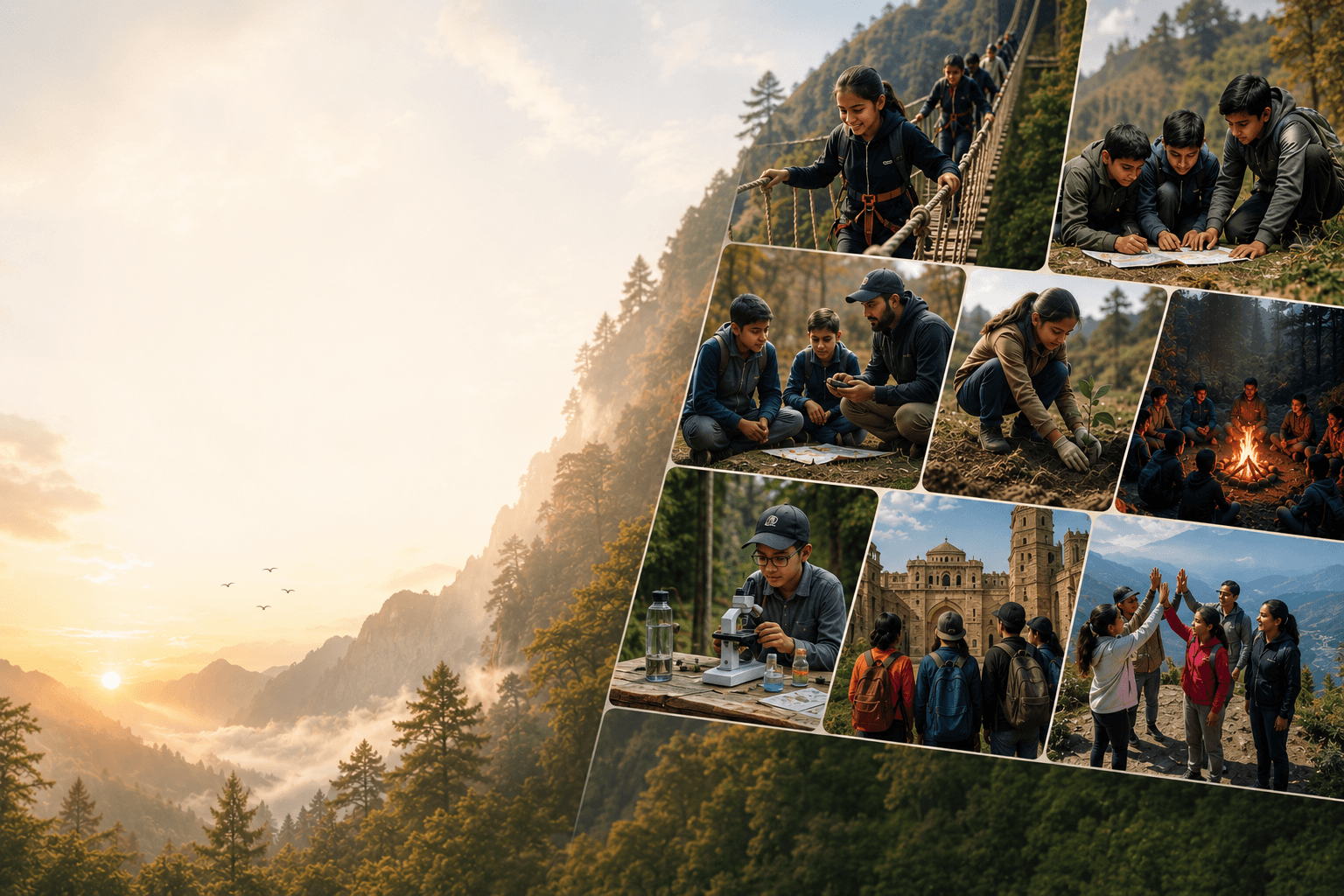
Structured learning journeys that help students develop leadership, confidence, teamwork, critical thinking and practical life skills through outdoor exploration, collaborative challenges, cultural immersion and guided reflection.
Why experiential learning?
Classrooms introduce ideas. Real-world experiences help students apply them. Through observation, exploration, teamwork, problem-solving and reflection, students learn how knowledge connects with life beyond textbooks.
Student competencies
Activities are selected for what they help students practise—not simply for where they take place.
Take responsibility, guide teams and make thoughtful decisions.
Listen actively, express ideas clearly and adapt to the group.
Share responsibility and work towards a common outcome.
Analyse real situations, evaluate options and question assumptions.
Step into unfamiliar situations with preparation and self-belief.
Test ideas, learn from setbacks and find practical solutions.
Respond constructively to challenge, uncertainty and change.
Understand human impact and practise responsible choices.
Our learning model
A repeatable structure helps turn a memorable activity into learning students can recognise and use.
Understand the environment, people and challenge.
Participate in practical and immersive activities.
Work in teams, communicate and share responsibility.
Discuss decisions, mistakes, emotions and learning.
Connect the experience to school, home and real life.
Demonstrate confidence, ownership and initiative.
Program themes
Choose a starting theme, then adapt the grade level, destination, duration, activities and reflection plan with our education team.
 School groups
Dharamshala, McLeod Ganj, Dal Lake, Bhagsu, Kangra Valley
A 4-day immersive journey exploring Tibetan culture, Himalayan ecology, and sustainable living in Dharamshala.
 School groups
Alappuzha, Vembanad Lake, Kuttanad, Kerala Backwaters
A 4-day immersive experience exploring Alappuzha’s backwater ecosystems, local communities, and sustainable lifestyles.
 School groups
Munnar, Tea Plantations, Eravikulam National Park, Mattupetty
A 4-day immersive experience exploring Munnar’s tea heritage, rich biodiversity, and sustainable farming practices.
 School groups
Joshimath, Auli, Nanda Devi Region, Mana Village, Himalayan Forests
A 5-day immersive expedition exploring the unique biodiversity, ecosystems, and conservation efforts of the Nanda Devi region.
 School groups
Kanha National Park, Kisli Zone, Khatia Zone, Kanha Museum
A 5-day field study exploring the Himalayan biodiversity, unique ecosystems, and conservation efforts in the Nanda Devi region.
 School groups
Balasore, Beach, Bhitarkanika
A 4-day field study exploring Chandipur’s unique disappearing beach, tidal ecosystems, and coastal science.
 School groups
Bhuj, Great Rann of Kutch, Hodka Village, Dhordo, Kala Dungar
A 4-day immersive experience exploring Kutch’s desert ecosystems, vibrant crafts, and rich cultural heritage.
 School groups
Ziro Valley, Hapoli, Apatani Villages, Talley Valley region
A 5-day immersive experience exploring Ziro Valley’s tribal culture, sustainable living practices, and natural landscapes.
 School groups
Shillong, Dawki, Umngot River, Mawlynnong, India–Bangladesh Border
A 4-day immersive experience exploring Dawki’s river ecosystem, borderland culture, and local communities.
 School groups
Shimla, Narkanda, Kalpa, Kaza, Key Monastery, Langza
A 6-day expedition exploring Spiti’s high-altitude landscapes, sustainable living, and climate resilience.
Education alignment
Designed in alignment with the broader goals of holistic, competency-based and experiential education.
School partnership
Schools remain involved from the first conversation through the post-program learning summary.
Understand the school context and student cohort.
Agree on age-appropriate learning priorities.
Build the itinerary, activities and reflection plan.
Prepare students for participation and responsibility.
Facilitate purposeful activities and real-world exposure.
Help students interpret what they experienced.
Capture participation, insights and next steps.
Close the loop with educators and families.
Learning outcomes
The learning continues in how students understand themselves, work with others and respond to the world around them.
Student voices
The most meaningful outcomes are often heard in students’ own words. Their stories reveal moments of challenge, confidence, connection and discovery that continue long after the journey ends.
Hear directly from students about the moments, friendships and learning they carried home.
Watch on InstagramEducator partnership
Teachers are learning partners—not only supervisors. Their context and observations make the experience more relevant before, during and after the program.
Planning and supervision
The final safety plan depends on the destination, activities, age group, partners and school requirements. These planning areas can be configured for each program.
Field notes
Look beyond the activity to the capability students are practising.
Showing 3 of 9 learning moments
School planning FAQ
Clear answers help schools plan a journey that is educationally relevant and operationally realistic.
Each journey begins with defined learning goals and combines activity, facilitation, observation and guided reflection. The destination supports the learning; it is not the sole purpose.
Programs can be adapted for primary, middle and senior-school students. Activities, duration and facilitation are adjusted for the age group.
Yes. Schools can shape the learning goals, duration, destination, subject connections and level of outdoor challenge.
AltairClub and the school agree on a small set of age-appropriate outcomes before the program, then design activities and reflection prompts around them.
Teachers help define goals, observe students, support reflection and connect learning back to classroom contexts.
Planning can include risk assessment, age-appropriate activity selection, facilitator and teacher coordination, emergency planning, first-aid readiness and weather contingencies.
Yes. Depending on the learning goals, programs can use local natural, cultural, community or institutional settings.
The communication approach is agreed with the school and can include program information, preparation guidance, consent requirements and post-program learning summaries.
Programs include contingency planning. Activities may be adapted, relocated or rescheduled in coordination with the school and partners.
A participation certificate or learning summary can be included when agreed during program design.
Yes. Themes can connect with science, environmental studies, social science, heritage, communication, entrepreneurship and other school priorities.
Earlier planning provides more choice and preparation time. Contact the team with your preferred dates, cohort size and goals to confirm a suitable timeline.
Tell us your students’ age group, learning goals, preferred duration and location. Our team will help structure a safe, engaging and outcome-driven school program.